
Technical · April 2026
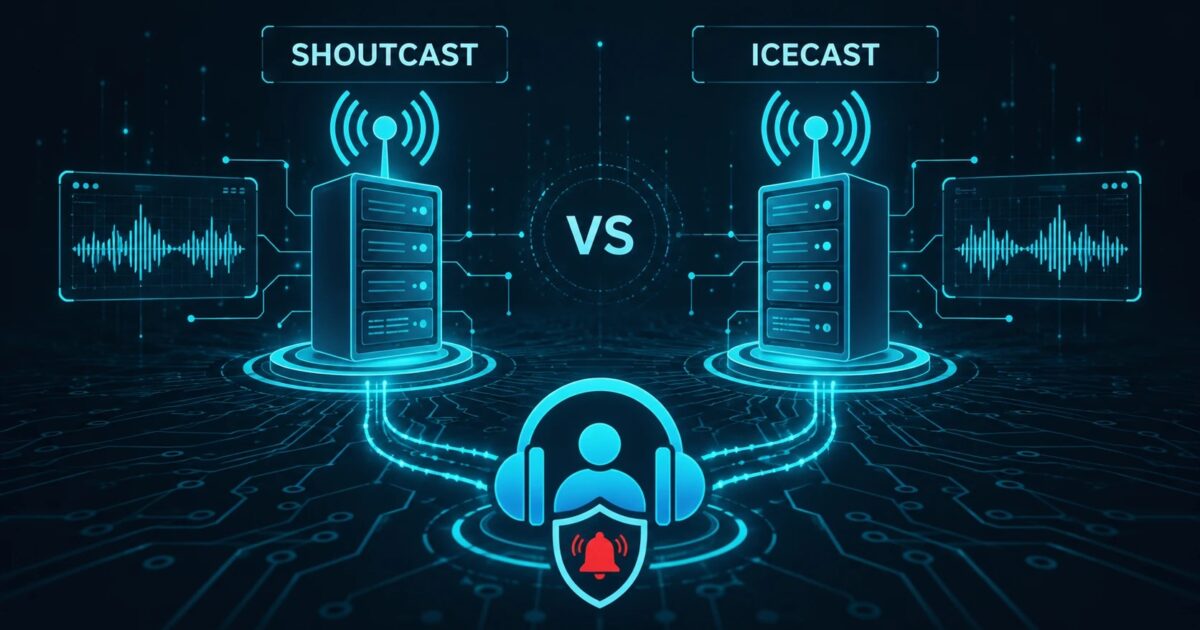
If you are setting up internet radio, Shoutcast and Icecast come up constantly. Both have been around for decades, both still run a lot of stations in 2026, and both accept a source feed and relay it to listeners. How they do that differs enough that the better pick depends on what you are building.
This article compares protocol, formats, metadata, scaling, licensing, community, and what neither server does for silence detection.
What Shoutcast and Icecast are
Shoutcast started at Nullsoft (Winamp) in 1999, later moved through Radionomy, and is now under Triton Digital. It popularized MP3 internet radio and uses its own ICY protocol on top of HTTP.
Icecast is an open-source streaming server from the Xiph.Org Foundation (the same group behind Ogg Vorbis and FLAC). It began as a free alternative to Shoutcast and is now used from community stations to larger deployments.
Same job at a high level: take audio from a source client, send it to listeners. The details diverge from there.
Protocol and standards
Shoutcast uses the proprietary ICY protocol (a modified HTTP/1.0 style). Player support is still wide, but the protocol does not track open-web evolution the same way. Shoutcast v2 improved parts of the stack; the core protocol stays closed.
Icecast serves listeners over standard HTTP and supports several source approaches, including its own protocol, a SHOUTcast compatibility mode, and paths toward WebM/HLS-style delivery for browsers. Standards-based HTTP usually fits better with web players, reverse proxies, and CDNs.
For modern web and CDN tooling, Icecast is usually easier.
Audio format support
| Format | Shoutcast | Icecast |
|---|---|---|
| MP3 | Yes | Yes |
| AAC / AAC+ | Yes (v2) | Yes |
| Ogg Vorbis | No | Yes |
| Opus | No | Yes |
| FLAC | No | Yes |
| WebM / Opus | No | Yes |
If you need Opus, Ogg, FLAC, or WebM, Icecast covers more ground. For a simple MP3 or AAC station, either works.
Metadata
Shoutcast puts metadata in the stream with the ICY metadata approach. It is reliable for plain “now playing” strings, but Unicode (especially non-Latin scripts) is a weak spot.
Icecast can do ICY-style inline metadata and also expose metadata through HTTP-oriented mechanisms. Unicode handling is stronger, which matters for international stations. Icecast also exposes status via XML/JSON endpoints that websites and dashboards can poll.
For non-Latin metadata or cleaner status integrations, Icecast is the safer default.
Latency
Under typical buffers and encoders, both land roughly in a 2–10 second end-to-end range. For music and scheduled programming that is usually fine. Shoutcast can feel a bit more predictable in very simple setups; Icecast is more tunable. Treat latency as a draw unless you are chasing talkback or ultra-tight cues.
Listener capacity and scaling
Icecast scales with a familiar master/relay layout: chain servers and spread load across regions. Shoutcast v2 added more multi-source/relay options, but Icecast’s open relay model and HTTP-native design tend to fit CDN and reverse-proxy setups with less friction.
For large or multi-region listener bases, Icecast is usually the more flexible base layer (often still paired with a CDN at real scale).
Licensing
Shoutcast is proprietary. DNAS/v2 is usable without paying for many basic setups; commercial terms and some features can still involve licensing with the vendor.
Icecast is GPL open source: run it, modify it, redistribute it under the license terms, without a proprietary server fee.
If you want no vendor lock-in on the server binary itself, Icecast wins on licensing clarity.
Community and documentation
Shoutcast still has a large legacy footprint and plenty of older tutorials (much of it from the 2010s). Active forum energy has thinned as development slowed.
Icecast still has current docs on icecast.org and maintenance under Xiph.Org. A lot of practical help now sits around stacks like AzuraCast, which many self-hosted stations use in 2026.
If you want current docs and an active self-host community, Icecast is ahead.
Silence detection (the shared gap)
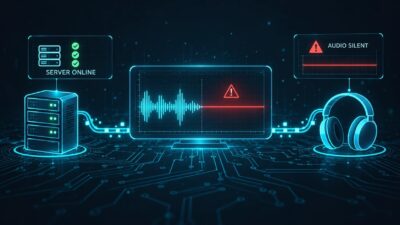
Neither Shoutcast nor Icecast ships real silence monitoring. If the source disconnects or sends quiet audio, the server will happily relay that to listeners. No alert fires from the server itself.
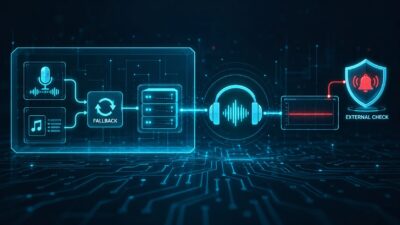
Icecast’s open stack makes it easier to bolt on tools (for example Liquidsoap scripts that fall back when levels drop). That is still encoder/automation logic, not independent monitoring of what listeners actually hear.
Streaming servers relay audio. They do not audit it. If you need to know when the public URL goes silent, use a separate monitor pointed at the same stream URL listeners use. SilenceAlarm works with Shoutcast and Icecast streams, watches for silence or disconnects, and can alert by email (and other channels on higher plans) without installing anything on the server.
Comparison summary
| Feature | Shoutcast | Icecast |
|---|---|---|
| Protocol | Proprietary ICY | Standard HTTP |
| Audio formats | MP3, AAC+ | MP3, AAC, Ogg, Opus, FLAC, WebM |
| Metadata | ICY inline (ASCII-limited) | ICY + HTTP-oriented (Unicode) |
| Latency | ~2–8 s in simple setups | ~2–10 s, more tunable |
| Scaling | CDN often needed at scale | Relays + CDN |
| Licensing | Proprietary (free tier exists) | Open source (GPL) |
| Development | Limited | Active (Xiph.Org) |
| Community | Legacy-heavy | Active (incl. AzuraCast) |
| Web / CDN fit | More limited | Stronger (HTTP-native) |
| Built-in silence detection | No | No |
| Fits best | Existing Shoutcast fleets, simple MP3/AAC | New stations, modern formats, open stacks |
Which should you choose?
Shoutcast still makes sense if you already run it, your players or directory workflow depend on it, or you only need a simple MP3/AAC path and do not want to migrate.
Icecast is the better default for most new stations in 2026: more formats, clearer licensing, better Unicode metadata, and a healthier tooling ecosystem (including AzuraCast).
Getting started
Pick the server that matches your constraints, then decide how you will notice dead air before listeners do. Pointing an external monitor at the public stream URL takes a couple of minutes and catches encoder and playlist failures the server will not report.